
Iowa Emotional Support Animal Laws (2026 Guide)
What Iowa law actually says about emotional support animals in housing, what HUD's May 2026 change did to it, and where the state stands compared with the rest of the country.
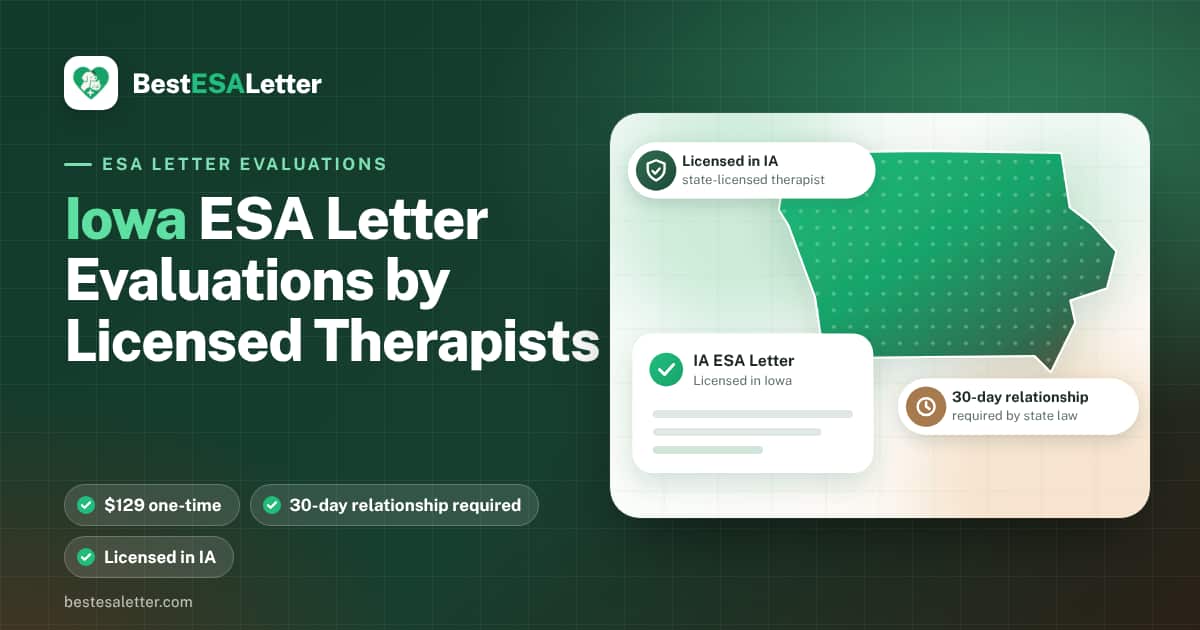
- State-law protection: moderate state backup — Iowa has a state fair housing law and an enforcement agency, but ESA-specific treatment is unsettled
- Waiting period: 30 days, required by statute
- Key statute: SF 2268 (2020), Iowa Code ch. 216
- Enforcement: Iowa Civil Rights Commission
- Public access rights: none — in Iowa or any other state
Two laws apply, and only one of them changed
Emotional support animals in Iowa housing sit at the intersection of a federal statute and a state one. Reading either in isolation gives a misleading picture, and most of what is published online reads only the federal half.
The federal Fair Housing Act requires housing providers to make reasonable accommodations in rules, policies, practices or services when necessary to afford a person with a disability equal opportunity to use and enjoy a dwelling. Congress has not amended that duty. What changed is how the enforcing agency reads it.
Iowa law adds SF 2268 (2020), Iowa Code ch. 216. That is a separate legal source with a separate enforcement body, and HUD's memorandum expressly states that state and local law is unaffected.
What HUD did on May 22, 2026
HUD's Office of Fair Housing and Equal Opportunity issued an enforcement memorandum permanently rescinding its 2020 assistance animal notice, FHEO-2020-01. In its place it adopted a training-based standard: FHEO will find reasonable cause and recommend charges only where the animal has been individually trained to perform work or tasks directly related to the complainant's disability.
This is essentially the ADA's service animal test imported into fair housing enforcement, with one difference worth noting — HUD's version is not limited to dogs. A trained animal of another species can still qualify.
Two consequences follow. Accommodation requests for trained assistance animals are treated as presumptively reasonable. Requests for untrained emotional support animals are not, and are assessed case by case.
What survived: the statute itself, the private right of action (generally a two-year window), Section 504 of the Rehabilitation Act in federally assisted housing, and all state and local law. HUD has said it intends formal notice-and-comment rulemaking to align its regulations with the ADA; that process has not concluded.
Iowa state law in detail
- SF 2268 (2020), Iowa Code ch. 216 30-day relationship, annual renewal, tenant liable for damage
Iowa requires a 30-day relationship and an annual renewal, so your letter here has a real expiration date you need to track.
The 30-day rule
Iowa requires a client–provider relationship of at least 30 days before a licensed professional may issue an emotional support animal letter. Five states impose such a rule: Arkansas, California, Iowa, Louisiana, Montana.
These provisions were written for a specific reason. Websites offering instant letters after a two-minute questionnaire were producing documentation that no therapist had any real basis for signing, and legislatures responded by requiring a relationship rather than a transaction. The practical effect is two appointments about a month apart.
A same-day letter marketed to Iowa residents does not comply with this rule. That is worth knowing before paying for one.
What a Iowa housing provider may and may not do
May: request reliable documentation of the disability-related need where neither the disability nor the need is obvious; verify that a licence is genuine; deny where the specific animal poses a direct threat that cannot be reduced, would cause substantial physical damage, or where the accommodation would be an undue financial or administrative burden; and rely on the federal exemptions for owner-occupied buildings of four units or fewer and single-family rentals let without a broker.
May not: demand medical records or a specific diagnosis; require certification, registration or proof of training for an emotional support animal; charge a fee to process the request; apply a breed or weight rule as an automatic bar without assessing the individual animal; or retaliate for the request having been made.
How Iowa compares
Iowa sits in the large middle group: a real state fair housing law and a functioning agency, but no settled answer yet on how untrained emotional support animals are treated after the federal shift.
| State | State-law backup | Waiting period | Enforcement |
|---|---|---|---|
| Iowa | Moderate state backup | 30 days | ICRC |
| Kansas | Moderate state backup | None | KHRC |
| Missouri | Moderate state backup | None | MCHR |
| Nebraska | Moderate state backup | None | NEOC |
Key dates
- HUD publishes FHEO-2020-01
Assistance animals, including untrained emotional support animals, are not pets and cannot be charged pet fees.
- DOT rule takes effect
Airlines may treat emotional support animals as pets. Unchanged since.
- Iowa enacts SF 2268 (2020), Iowa Code ch. 216
30-day relationship, annual renewal, tenant liable for damage
- HUD withdraws its 2013 and 2020 notices
Removed as part of a broader clearing-out of sub-regulatory guidance.
- Training-based enforcement standard adopted
FHEO pursues complaints only for individually trained assistance animals. State and local law unaffected.
Air travel
No state, Iowa included, can change air travel rules. The Air Carrier Access Act and its implementing regulation at 14 C.F.R. Part 382 are federal, and since January 2021 airlines have been permitted to treat emotional support animals as ordinary pets — carrier fee, size limit, under the seat. Trained service dogs travel in the cabin at no charge with the DOT Service Animal Air Transportation Form, which the handler attests to rather than a therapist signing.
Practical takeaways for Iowa renters
- Get documentation from a therapist licensed in Iowa, and start at least 30 days before you need it.
- Make the accommodation request in writing, naming the specific policy you want modified.
- Do not attach a purchased registration or certificate. No registry exists, and their presence undermines a real letter.
- Keep every message. Case-by-case analysis is decided on records.
- Know that Iowa Civil Rights Commission is a state-level route independent of HUD's enforcement policy.
Questions
Iowa ESA Law FAQs
Are emotional support animals protected by law in Iowa?
In housing, yes — though the source of that protection changed in 2026. The federal Fair Housing Act still requires housing providers to consider reasonable accommodations, and Iowa adds its own through SF 2268 (2020), Iowa Code ch. 216, enforced by Iowa Civil Rights Commission. Outside housing, emotional support animals have no access rights anywhere in the United States — that belongs to trained service animals under the ADA.
Does Iowa require a waiting period before an ESA letter?
Yes. Iowa is one of five states — alongside Arkansas, California, Louisiana, Montana — that require an established client–provider relationship, generally at least 30 days, before a mental health professional may issue an emotional support animal letter.
Can a Iowa landlord charge a pet deposit for an emotional support animal?
Before May 2026, HUD guidance said no for any assistance animal. That guidance was rescinded, and HUD now treats fee waivers as presumptively reasonable only for animals individually trained to perform a disability-related task. In Iowa the answer now depends on state law and on the individual case. Damage actually caused by an animal has always been chargeable, in every state.
Is it illegal to fake an ESA letter in Iowa?
Iowa has no ESA-specific penalty statute, but submitting documentation you know to be false is fraud, and misrepresenting an animal as a trained service animal is a criminal offense in a large number of states. Obtaining a letter from a licensed therapist who has actually evaluated you is legal everywhere.
Who can write an ESA letter in Iowa?
A healthcare professional holding an active Iowa license — typically a licensed psychologist, clinical social worker, professional counselor, marriage and family therapist, psychiatrist or psychiatric nurse practitioner. Licensure is state by state even when the appointment is by video, which is why an out-of-state signature is the most common reason a letter is rejected.
Where do I file a housing discrimination complaint in Iowa?
With Iowa Civil Rights Commission at state level, or with HUD through the HUD Great Plains Regional Office (Region VII). A private lawsuit under the Fair Housing Act is also available, generally within two years.
Do emotional support animals fly in Iowa?
Air travel is federal and state law does not touch it. Since the Department of Transportation's rule took effect on January 11, 2021, airlines may treat emotional support animals as pets. Trained service dogs still fly in the cabin with DOT forms attested by the handler.
Sources
- SF 2268 (2020), Iowa Code ch. 216 — look it up in the Iowa Code Iowa Legislature
- Iowa Civil Rights Commission — official site State of Iowa
- HUD Great Plains Regional Office (Region VII) — serves Iowa U.S. Department of Housing and Urban Development
- Fair Housing Act, 42 U.S.C. § 3604 — discrimination in the sale or rental of housing Office of the Law Revision Counsel, U.S. House of Representatives
- 24 C.F.R. Part 100 — HUD regulations implementing the Fair Housing Act Electronic Code of Federal Regulations
- File a housing discrimination complaint with HUD HUD Office of Fair Housing and Equal Opportunity
- ADA 2010 Revised Requirements: Service Animals U.S. Department of Justice, Civil Rights Division
Next
Getting a Letter in Iowa
This guide covers what the law says. If you are trying to actually obtain documentation — who can sign it, what it costs, how long it takes here — that is a separate page.
Related guides